Saturday, April 26, 2014

Erin Addison Saving Other Women from Other Men: Disney's Aladdin


Growing up I had Aladdin as well as the sequel Aladdin Jafar's Return on VHS. I could never get tired of this movie. When I read Addison's piece regarding the film, where she criticizes the representation of race in the film, I realized I had been tricked by Disney, or rather swayed. One of the things that Addison discusses is the representation of the main characters, Aladdin and Jasmine, in contrast with the representation of all the other characters in the film. While most characters in the film possess a foreign accent, the main characters coincidently have American accents (Addison 9). On top of that, Addison points out that Aladdin is the "only clean shaven male in the movie" (Addison 9).

When I watched this film, naturally Aladdin was my favorite character. But now I ask myself, did I pick him as my favorite character in the movie, or did Disney pick for me? The animators design Aladdin so that he is so different from the rest of the cast that he stands out. His clean look, american accent, and light skin are much more relatable to any young boy than the rugged, foreign accent, bearded law enforcement that appear in the film. Is this the first time that I have been lightly swayed in a direction by Disney and its creators?

Gillam Post-Princess Models of Gender: The New Many in Disney/Pixar


Gillam's analysis of the alpha male character in Disney and Pixar films was illuminating. The presence of an alpha male is not a new concept. In many sports, movies, shows, and even in the wild there is almost always one person or animal, who stands out from the rest as the leading alpha. The alpha character has been in countless Disney films over the decades. Disney really pushed the characteristics of the alpha in Beauty and the Beast. Anyone who has ever seen Beauty and the Beast, immediately remembers the alpha male, Gaston. With bulging biceps, a chin cleft, an abundance of chest hair, and the title of greatest hunter in all the land, Gaston becomes an image of mockery rather than respect in the film.

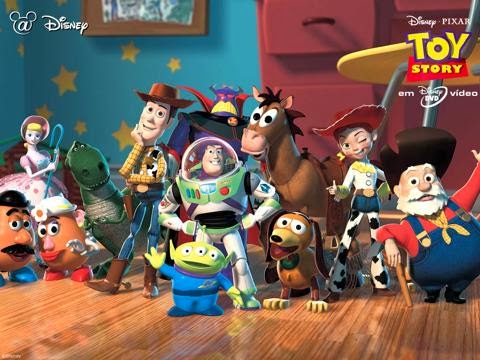
In the three films that Gillam discusses: Cars, Toy Story, and The Incredibles, Gillam addresses that each alpha male character experiences some type of fall from grace, and eventually builds himself back up. However the male characters do not return as stronger alphas, they return as discussed in the article as "betas"(Gillam 3-6) In fact Gillam believes argues that the alpha position is always temporary. He says that "In none of these Pixar films does the male protagonist's dominance last long." (4)  Consequently these alphas lose their dominance and create a new persona as betas.

I thought about what Gillam was saying, and it changed the way that I personally experienced Disney films. All throughout my childhood I watched and adored the alpha characters portrayed in these films. I wanted to emulate their alpha model. As I have said, Mufasa, perhaps one of the most iconic alpha males in Disney history, is my favorite character. But as I look back at each and ever one of these movies with the alpha males that I grew up adoring, I realized that Gillam was right; the alpha role is not really sustainable or at least Disney doesn't allow it to be sustainable in its films. I re-watched the Lion King recently and for the first time in awhile, noticed something new. Simba's reliance and cooperation with his allies as a beta allows him to be successful and reclaim his home. If Mufasa had called the other lionesses for help,  and not been a stereotypical alpha who works alone, could he have survived? But then he really would not have fit the alpha stereotype, if he didn't go alone.


Ackerman's The Spirit of Toys: Resurrection and Redemption in Toy Story and Toy Story 2


Alan Ackerman discusses several of the concepts that are present in Disney Pixar's Toy story films. One of his arguments that really popped out to me was the notion of death, humanity, and perfection . Ackerman argues that death is present and "imagined obsessively in both movies"(Ackerman 896). I definitely agree that there are themes of death and humanity throughout the film. As Ackerman points out, the character Sid is an image of death, some might even argue that he is the grim reaper, who in a twisted way escorts toys to their doom by destroying them with tools and toy rockets. Sid's skull shirt further credits the theory that he is the presence of death in the film. Toys like Buzz, eventually realize his own humanity when he  attempts to fly and gloriously fails, breaking into a few pieces (Ackerman 897) . No arguments there with Ackerman.  However what I found particular interesting about his analysis of the second film was the toys' idea of death in connection to perfection.

Ackerman once again points out references to death in the form of storage that Jessie and other toys are placed in before finding Woody (904). This idea of keeping toys in storage or their original boxes in mint condition sparked a curiosity in me. Death for these toys may not be as literal as being destroyed, but rather not being played with feels equally as painful. I started to notice that throughout the second film, the toys are obsessed with being perfect. When Woody's arm is ripped, he becomes visibly worried and upset, fearing that because he is partially damaged, Andy won't want to play with him anymore and subsequently feels like he has died. Jesse and the other television characters are excited to be on display in the museum because they will be in mint condition and perfect forever. I feel that Woody subsequently realizes, at the point and level of perfection, they aren't really living.

This made me think about images of perfection in the real world. There are people who go through their lives trying to achieve perfection as if anything less would be comparable to death. I feel that the presentation of perfection to death in Toy Story allows people to take a step back and realize that life is not always about being perfect, and sometimes being a little rough around the edges is just fine.


Tuesday, April 22, 2014

Subliminal and Hidden Messages In Disney Films


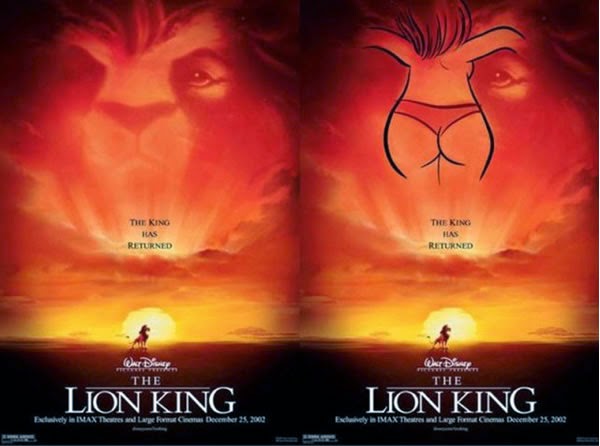
As people have examined Disney and Pixar films over the years, some people have picked up on certain hidden messages that were left by the animators. Sometimes it can be as harmless as a Buzz light year toy in Finding Nemo, but on other accounts like the controversial penis portrayed on the cover of Little Mermaid, discussion has stirred. These creations are not left by accident. It would be very interesting for anyone to prove that they accidentally put obscenities on a Disney cover however it begs the question, "have I found everything?" I wondered as I looked through this article and watched some Disney movies recently, are these messages the ones that perhaps we were meant to find if we scratched at the surface? Could there possibly be far more controversial animated additions in films that we have never noticed?

I challenged myself to watch a few films that have already identified hidden messages, and alas I was not able to find anything interesting. However, I believe that there could be more messages within these films that may possibly never be discovered, and the animator who put it there has a slight chuckle every day as his little addendum to the film has not yet been uncovered.


http://www.ultimatetop10s.com/wp-content/uploads/2013/06/Lion_King_Subliminal_Message.jpg